
SAFETY & STANDARDS
Professional Service Requires Professional Standards.
NPSA provides specialized environmental cleaning, sanitation, remediation, surface care, incident response, and preventive-maintenance services across a variety of facilities and environments.
Our service approach emphasizes appropriate product use, surface compatibility, worker safety, facility coordination, environmental responsibility, documentation, and clearly defined scopes of work.
The goal is simple:
Perform the right service. Use the right method. Document the work.
OUR SERVICE STANDARD
Safety Begins Before Service Starts.
NPSA does not believe every facility, surface, or environmental condition should be treated the same way.
Before performing qualifying services, our process may consider:
Facility type
Surface materials
Current condition
Environmental buildup
Product compatibility
Approved use sites
Manufacturer instructions
Access requirements
Personnel and public exposure
Required PPE
Facility-specific restrictions
Environmental and wastewater considerations
Documentation requirements
We select the service method around the environment not the other way around.
THE NPSA SAFETY FRAMEWORK
-
PRODUCT SELECTION
Products are selected according to the intended service, approved use site, surface compatibility, label directions, and facility requirements.
-
SURFACE COMPATIBILITY
Cleaning and treatment methods are evaluated according to material type, condition, age, surrounding environment, and manufacturer guidance where applicable.
-
WORKER PROTECTION
Service procedures incorporate appropriate PPE, chemical-handling practices, equipment requirements, and job-specific safety considerations.
-
FACILITY COORDINATION
NPSA coordinates access, scheduling, treatment areas, re-entry considerations, and operational requirements with the client when applicable.
-
ENVIRONMENTAL CONSIDERATIONS
Outdoor and specialty services are evaluated for runoff, wastewater, surrounding property, drainage, vegetation, waterways, and other site-specific considerations where relevant.
-
DOCUMENTATION
Applicable services are supported with records identifying what was performed, where it occurred, and other relevant service information.
NPSA PLAYGROUND SERVICE PROTOCOL
A Structured Approach From Initial Cleaning Through Final Review
NPSA playground services are performed according to the approved scope, current facility conditions, surface compatibility, product requirements, and service objectives.
When conditions require a more comprehensive initial treatment, our playground service protocol may include three distinct stages designed to address accumulated environmental buildup, perform appropriate targeted treatment, and prepare the structure for return to service.
Not every playground requires every treatment step. Service methods and products are selected according to the facility, surface, current condition, approved scope, and applicable product labeling.
TARGETED DEEP CLEANING
For playgrounds experiencing significant environmental buildup or extended periods without specialized service, NPSA may begin with a targeted deep-cleaning process.
MAY ADDRESS:
Dirt & environmental residue
Organic buildup
Algae
Mold & mildew
Biofilm or surface buildup
Weather-related staining
PURPOSE: Establish a cleaner baseline before additional treatment or recurring preventive maintenance.
TARGETED DISINFECTION
Following cleaning, NPSA may apply an appropriate EPA-registered disinfectant when disinfection is included in the approved service scope and the product label permits use on the applicable surface and use site.
OUR PRODUCT STANDARD:
EPA-registered product where applicable
Approved use site confirmed
Surface compatibility evaluated
Product applied according to label directions
Required contact/wet time followed
Required rinsing or post-treatment instructions followed
Treatment information documented
NPSA does not assume that every product is appropriate for every playground surface or that every outdoor surface requires disinfection.
FINAL RINSE, SURFACE REVIEW & REOPENING
Following applicable treatment, NPSA completes required rinsing and post-treatment procedures according to the product label, surface requirements, approved scope, and service protocol.
THIS STEP MAY INCLUDE:
Label-directed rinsing
Removal of remaining cleaning residue
High-volume potable-water rinsing where appropriate
Final visual surface review
Surface-condition observations
Drying time
Site reopening instructions
Post-service documentation
If a product label requires specific rinsing, drying, ventilation, re-entry, or other post-treatment procedures, those instructions take priority.
High-volume final rinsing where appropriate
CLEAN FIRST. TREAT APPROPRIATELY. VERIFY BEFORE REOPENING.
NPSA's process is designed around the actual condition of the facility not a one-size-fits-all treatment. The approved service method may vary based on surface material, environmental conditions, contamination concerns, products, manufacturer recommendations, and client requirements.
INITIAL DEEP CLEANING PRECAUTION
NPSA 24-Hour Precautionary Closure Policy
When sodium hypochlorite is used as part of a qualifying initial Deep Cleaning & Remediation service, NPSA recommends that the treated playground structure remain closed to use for 24 hours following completion of service.
This 24-hour period is an NPSA precautionary operating policy designed to provide additional time for completion of required rinsing, surface drying, post-service review, and return-to-use preparation.
IMPORTANT
The NPSA 24-hour precautionary period does not replace or override product-label instructions. If the applicable product requires additional rinsing, drying, re-entry restrictions, or other precautions, those requirements must be followed.
SCHOOL & CHILDCARE SCHEDULING
We Plan Around Your Operating Schedule.
When possible, NPSA will coordinate qualifying initial playground Deep Cleaning & Remediation services during weekends, school breaks, holidays, or other low-occupancy periods.
This scheduling approach is intended to provide adequate time for post-service procedures and NPSA's 24-hour precautionary closure period while minimizing disruption to normal school, childcare, park, or facility operations.
BEFORE REOPENING
NPSA verifies applicable post-service requirements, which may include:
✓ Required contact time completed
✓ Applicable rinsing completed
✓ Surfaces visually reviewed
✓ Surface drying completed
✓ Site conditions evaluated
✓ Applicable product-label requirements satisfied
✓ Service documentation completed
The facility is not reopened simply because the clock reached 24 hours. Applicable product instructions and site conditions still govern return to service.
RECURRING SERVICE APPROACH
Following a qualifying initial deep-cleaning service, NPSA's recurring playground programs are designed to rely on routine cleaning, appropriate preventive care, and targeted EPA-registered products where warranted rather than repeating aggressive restoration-oriented treatment unnecessarily.
Product selection for future services depends on facility conditions, surface compatibility, approved service scope, product labeling, and actual service needs.
NPSA selects products appropriate for the approved use site and follows applicable label directions, surface requirements, contact times, post-treatment procedures, and restrictions.
EPA/Product Standards
EPA-REGISTERED PRODUCTS & LABEL-DIRECTED USE
Product Claims Start With the Label.
When NPSA uses an antimicrobial pesticide or disinfectant, product selection and application should be based on the EPA registration, approved use site, surface type, target organism where applicable, application method, required contact time, precautionary language, and other label directions.
EPA specifically states that disinfectants are registered for defined uses and that users need to read the product label to determine whether a product is appropriate for the intended use site and organism. The surface may also need to remain visibly wet for the full contact time stated on the label.
NPSA PRODUCT STANDARD
EPA-registered where registration is applicable.
Used according to applicable product labeling.
Approved use site confirmed before antimicrobial application.
Surface compatibility evaluated.
Contact time followed where required.
Product documentation available upon request.
CLEANING, SANITIZING & DISINFECTING ARE NOT THE SAME THING
CLEANING
Cleaning removes dirt, debris, organic material, and impurities from surfaces using appropriate cleaning methods.
SANITIZING
Sanitizing reduces microorganisms to levels associated with the specific product claim or applicable standard when performed according to approved product directions.
DISINFECTING
Disinfecting uses an appropriate EPA-registered disinfectant according to its label directions to address specified microorganisms on approved surfaces and use sites.
NPSA determines the appropriate service based on the facility, surface, current condition, intended outcome, and approved scope. Not every surface requires or is appropriate for disinfection.
ONE METHOD DOES NOT FIT EVERY SURFACE
NPSA services multiple materials across playgrounds, buildings, recreational facilities, campuses, commercial properties, and public environments. Cleaning pressure, products, temperature, dwell time, tools, and treatment methods must be selected with the surface in mind.
Plastic & Composite Playground Surfaces
Metal
Concrete & Masonry
Brick
Stone
Painted & Coated Surfaces
Artificial Turf
Commercial Exterior Materials
Interior Hard Nonporous Surfaces
Specialty Assets
Some surfaces, materials, coatings, historic assets, manufacturer-controlled equipment, or specialty environments may require additional review or may fall outside NPSA's approved service capabilities.
CHEMICAL SAFETY & SAFETY DATA SHEETS
Products used in professional environmental services can have specific handling, storage, PPE, first-aid, exposure-control, and disposal requirements. NPSA uses applicable product labels and Safety Data Sheets as core sources of safety information when planning and performing services.
SAFETY DATA SHEETS
SDS documentation for applicable service chemicals can be made available to clients upon request and as part of appropriate onboarding or service documentation.
CHEMICAL HANDLING
Products are handled, mixed, stored, transported, and applied according to applicable manufacturer instructions, labeling, SDS information, and operating procedures.
PERSONAL PROTECTIVE EQUIPMENT
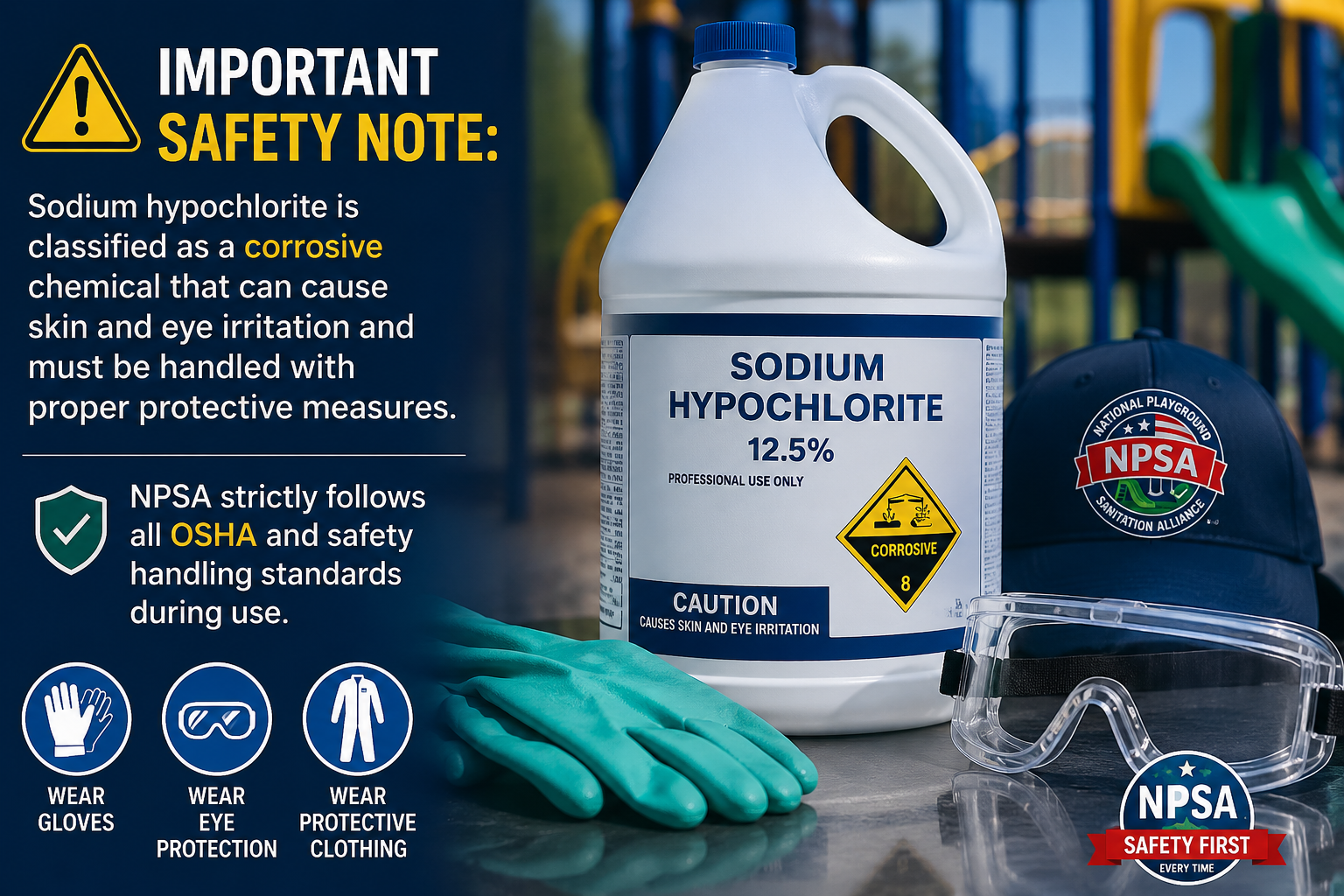
Appropriate gloves, eye protection, protective clothing, respiratory protection, or other PPE may be required depending on the product, equipment, exposure potential, and task.
HAZARD COMMUNICATION
NPSA's worker-safety program should include appropriate chemical identification, SDS access, product labeling, and employee training for hazardous chemicals used in service operations.
OSHA's Hazard Communication Standard requires covered employers to maintain SDSs, chemical information/labels, and worker training for hazardous chemicals.
INDOOR FOGGING & SPECIALIZED APPLICATIONS
Application Method Matters.
NPSA does not assume that a disinfectant may be fogged simply because it can be sprayed or wiped onto a surface.
Fogging or misting applications are considered only when the product labeling, approved application method, use site, facility conditions, and service scope support that method.
Before qualifying indoor fogging services, considerations may include:
Product label authorization
Treatment method
Facility type
Occupancy
HVAC or ventilation considerations
Surface compatibility
Preparation requirements
Treatment area
Required contact time
Re-entry requirements
Post-treatment procedures
Client facility protocols
SPECIALIZED REMEDIATION PRODUCTS
Certain Deep Cleaning & Remediation projects may require stronger or specialized cleaning products based on the severity of mold, mildew, algae, organic buildup, staining, surface condition, and approved scope.
Where sodium-hypochlorite-containing or other specialized products are used, NPSA evaluates the product, intended application, surface compatibility, required PPE, surrounding environment, labeling, SDS information, and applicable treatment procedures before service.
IMPORTANT
Specialized remediation products are not automatically used on every facility, every surface, or every recurring service visit.
Product selection is determined by the approved service scope and site conditions.
INCIDENT RESPONSE & EXPOSURE CONSIDERATIONS
Bodily-fluid incidents and other contamination events require a different level of evaluation than ordinary routine cleaning.
Depending on the circumstances, NPSA may evaluate:
Nature of the contamination
Affected surface or area
Worker exposure potential
Required PPE
Cleaning and decontamination method
Appropriate disinfectant
Waste handling
Access control
Documentation
Whether the incident falls within NPSA's service capabilities
SAFETY FIRST
NPSA reserves the right to decline or refer conditions requiring capabilities, licensing, disposal procedures, medical-waste handling, hazardous-material response, or other specialized services outside our approved scope.
ENVIRONMENTAL & SITE CONSIDERATIONS
Exterior service involves more than selecting a cleaning machine.
Depending on the site and approved scope, NPSA may evaluate:
Drainage
Stormwater pathways
Wastewater
Nearby vegetation
Waterways
Pedestrian and vehicle traffic
Adjacent property
Product use
Containment requirements
Surface runoff
Weather conditions
Environmental controls and service procedures depend on the specific property, jurisdiction, service method, product requirements, and approved scope.
PROFESSIONAL SERVICE STARTS WITH THE OPERATOR
-
TRAINING
Operators receive training applicable to the services they are authorized to perform.
-
EQUIPMENT
Operators are expected to understand proper equipment setup, operation, inspection, and shutdown procedures.
-
PPE
Required PPE is based on service conditions, product information, exposure potential, and operating procedures.
-
PRODUCT KNOWLEDGE
Operators must understand relevant product labels, SDS information, dilution/application instructions, and applicable restrictions.
-
SITE CONDUCT
Professional appearance, client communication, site respect, access control, and operational discretion are part of the NPSA service standard.
-
DOCUMENTATION
Operators are responsible for completing applicable service records and documenting identified conditions and completed work.
CONSISTENCY REQUIRES A SYSTEM
NPSA is developing standardized operating procedures designed to help maintain consistent expectations across service locations, operators, and client programs.
Our framework emphasizes:
Defined scopes of work
Service checklists
Product records
Equipment requirements
Site-specific considerations
Before-and-after photography
Condition observations
Client reporting
Recurring service histories
Follow-up recommendations
Quality-control review where applicable
The objective is not simply to complete the work.
It is to build a repeatable professional service standard.
DOCUMENTATION & ACCOUNTABILITY
Know What Was Done. Where. When.
Depending on the service and approved program, NPSA documentation may include:
Facility identification
Service date
Areas and structures serviced
Pre-service observations
Before photographs
Products or treatment methods
Post-service photographs
Observed concerns
Follow-up recommendations
Technician/service verification
Recurring service history
IF IT'S NOT DOCUMENTED, IT DIDN'T HAPPEN.
WHAT NPSA DOES NOT CLAIM
Professional standards also require clear boundaries.
NPSA DOES NOT CLAIM THAT:
Every surface requires disinfection.
Every product is appropriate for every environment.
Cleaning can eliminate all environmental risk.
Sanitation can guarantee that illness will never occur.
A service can guarantee that a client will never face liability.
NPSA replaces an organization's custodial, facilities, safety, infection-prevention, maintenance, or risk-management professionals.
Every contamination incident falls within NPSA's capabilities.
Every application method is appropriate simply because a product is EPA-registered.
We believe credibility comes from performing appropriate services not making impossible promises.
NEED PRODUCT OR SAFETY DOCUMENTATION?
Organizations evaluating NPSA services may request applicable materials such as:
Safety Data Sheets
Product information
EPA registration information where applicable
Insurance documentation
Service procedures
Scope-of-work information
Treatment records
Vendor information
PROFESSIONAL SERVICE STARTS WITH THE RIGHT SCOPE.
Tell us about your facility, surfaces, environmental conditions, and service needs. NPSA will help determine which services and treatment methods may be appropriate.
No obligation. Our team will review the information provided and discuss appropriate next steps.